|
 Print Print
|
Site Navigation
 Home HomeProjects & Information
»General Information»Wind turbine Projects »The F&P Smartdrive »Electronic projects »Microcontroller projects »Miscellaneous Kits & Parts
»Basicly Natural Pty Ltd»PVC & Aluminium blades »Scale model farm windmills »Price Watch Discussion Forums
Handy Links
»Wind»Solar »Electric Vehicles »Electronics »Micro Controllers »General Interrest About TheBackShed Getting Started Privacy Policy |
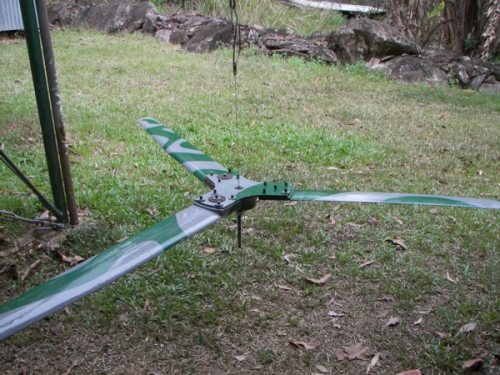
String Method, by forum members Gill with a little help from Klaus and Don. "I have found this method most satisfactory. It gives a high degree of accuracy for the static balancing of a prop.
Here is an action shot with no movement evident.
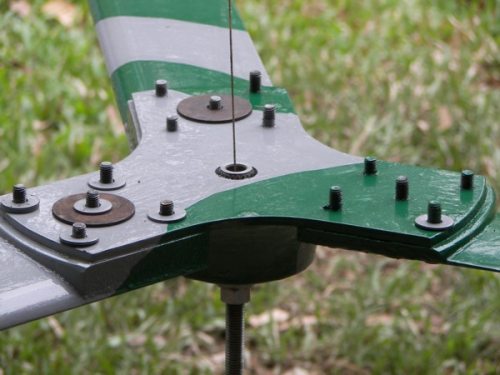
With this method the prop is a beam balance and the string entry to the plug is the fulcrum. A little balance theory now:
|
||||
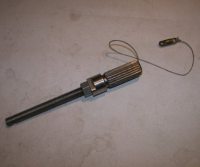
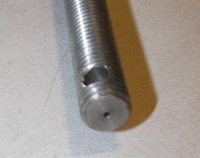
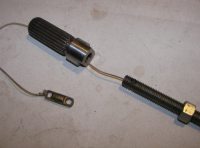
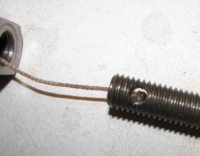
Here is the stub off an F&P shaft I made to plug the hole and provide a fulcrum with a centre of gravity adjustment.
The main thing to note if you make your own, is that for consistency, the thread must be firm and the string must be tight through the string hole. Method:
Never fear, most will go to far to a neutral or accelerating action and get odd and confusing readings. Just go back a little. Well that's how I do mine. Hope you have fun. Gill" "Hi Gill,
Did I get it? Very clever, your method that is. Klaus" "Your spot on working out what I didn't say. It's a YES to each question though the backside facing upward is because the CofG is closer to that face on this prop. If the blades protruded forward and the C of G was to be near or even further forward than the front of the hub, then that face would need to be uppermost. In such cases the threaded rod can protrude past the splined stub to position the fulcrum in correct relation to the C of G even if the C of G appears to be in no-mans-land. Gill" Don Brown has made the following notes... "The sensitivity of the balancing arrangement will be affected by the length and weight of the bolt or threaded section used for balancing. Good point, thanks Don. |
|||||