|
 Print Print
|
Site Navigation
 Home HomeProjects & Information
»General Information»Wind turbine Projects »The F&P Smartdrive »Electronic projects »Microcontroller projects »Miscellaneous Kits & Parts
»Basicly Natural Pty Ltd»PVC & Aluminium blades »Scale model farm windmills »Price Watch Discussion Forums
Handy Links
»Wind»Solar »Electric Vehicles »Electronics »Micro Controllers »General Interrest About TheBackShed Getting Started Privacy Policy |
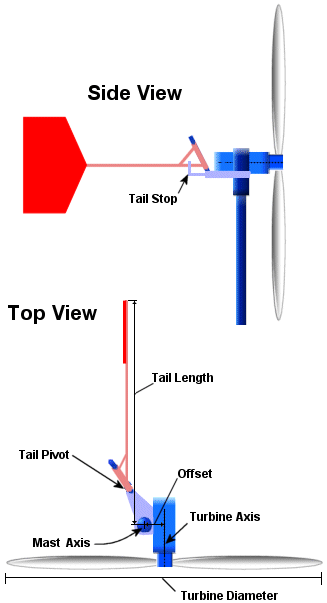
The automatic furling system used on small windmills is, at first, one of the hardest concepts to grasp. But once you understand how it works, it all makes sense as a simple and effective way to furl the windmill in high winds. Before I go any further, I should mention I get a LOT of emails asking me to explain the principles and mathematical formula of furling in more detail. Sorry, but this page explains the furling system as best as I can, so I will ignore any requests for more information. I do suggest you use a search engine to find more information, or build a model. There are also examples of windmills furling on YouTube. Once you see the system in action it will all make sense. Also note the math formula's used are not an exact science, they will give you a ball park figures only. The only way to fine tune the furling of your windmill is through experimentation in the real world. There are several methods to mechanically control a wind turbine, like tilt up turbines, changing blade angle, and spoilers. On this page we will look at the most common system used on small windmills, side furling. Why do we use furling? Well it will save your windmill from destruction in high winds, effectively making it "safe", and it provides output power regulation. Manual furling systems, like those on the old Southern Cross windmills, use a manually operated lever or switch to turn the turbine out of the wind. This is done by changing the tail angle, instead of pointing straight out the back, its turned up to 90 degrees.The tail will always be down wind, so the wind against the tail will turn the front of the turbine away from the wind. Automatic furling can be either electronic or mechanical. Electronic furling uses wind speed and direction sensors and a small computer to drive an electric motor, which turns the windmill in or out of the wind. This type of furling is used on the large wind farms. Automatic mechanical furling uses a clever combination of gravity and wind force. Below is a simplified diagram of a windmill. The Tail Pivot is just a simple hinge that is angled back and to one side, usually with an angle of about 20 degrees. Because the pivot is angled back from the vertical, the weight of the tail will want to turn the tail down. Its a bit like a fridge door, if you tilt you fridge towards you, the door will open because the fridge door hinge it angled off from the vertical. There is a tail stop to stop the tail once it is pointing straight out the back of the windmill, at 90 degrees to the turbine. The windmill turbine is offset to one side from the tower/mast axis, so if you push against the turbine, it will want to swing around the mast axis.
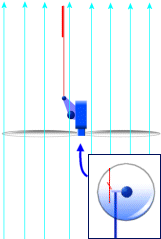
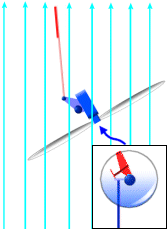
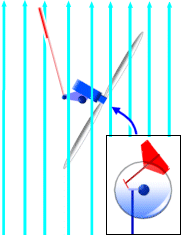
In operation, the force of the wind against the turbine will want to turn it around the mast axis, however the tail, which is sitting against the tail stop and at 90 degrees to the turbine face, will want to stay down wind, so it keeps the turbine facing the wind. But as the wind picks up, the force against the turbine face increases until it is high enough to lift the tail off the tail stop. |
||||||
We can use some maths to calculate how a tail will furl, but first we need some measurements, and all measurements are in metric ( Conversion to imperial tables here ).
You can measure the tail tip weight by placing the pivot end of the tail on a fulcrum ( block of wood ) and the tail end on a set of scales. First we need to work out how much torque is trying to turn the windmill around the mast axis. The turbine thrust or force can be worked out with -
The turbine moment ( torque ) is -
Say our turbine has a diameter of 2 meters, and we want it to start fuling in winds above 20 meters per second ( 72kmh ). Our mast offset is 0.1 meters ( 100mm ).
So we need a tail moment of 6.66kgM to balance the turbine moment.
So for our windmill to start furling at 72kmh, it needs a tail pivot angle of 200, a tail lenght of 1.378m and weight of 20kg. Calculations:
Notes: As well as the tail stop where the tail is pointing straight out the back, add a tail stop at the other end of the tails travel, this will stop the tail in extreme conditions going around so far that it hits the turbine blades. It does happen and has ruined many a good set of windmill blades. A big thanks goes to Ed ( http://www.windstuffnow.com/ ) for helping with the information above, and also Gill for his additions. |
|||||||