AlbertR
Senior Member

Joined: 29/05/2025
Location: GermanyPosts: 111 |
| Posted: 11:26am 31 Aug 2025 |
 Copy link to clipboard Copy link to clipboard |
 Print this post |
|
I make some tests with the Picomite PIO for the WS2812-Output.
Because the implemented function "Device WS2812" is blocking during output-time, I was looking for an other possibility. The PIO should be a candidate.
Option EXPLICIT
Option DEFAULT NONE
Dim integer leds(255)
Dim integer pack(127)
Dim integer Busy = 0'as Mutex: ready to send
SetPin gp22,pio1
' The PIO program - PIO WS2812 driver on GP22 --------------------------------
' ____ ________
'(0) __| |______ (1) __| |__
' .2us .4us .6us .2us .8us .2us
PIO CLEAR 1
PIO ASSEMBLE 1, ".program leds"
PIO ASSEMBLE 1, ".line 0"
PIO ASSEMBLE 1, "SET PINDIRS, 1"
PIO ASSEMBLE 1, ".wrap target" 'steps |delay
PIO ASSEMBLE 1, "OUT x, 1 " '1 lo 0.2us
PIO ASSEMBLE 1, "SET PINS, 1 [1]"'2 hi 0.4us
PIO ASSEMBLE 1, "MOV PINS, x [1]"'2 data 0.4us
PIO ASSEMBLE 1, "SET PINS, 0 " '1 lo 0.2us
PIO ASSEMBLE 1, ".wrap" '6 sum 1.2us = 833kHz
PIO ASSEMBLE 1, ".end program list"
Dim integer ExeC = Pio(execctrl GP22,Pio(.wrap target),Pio(.wrap))
Dim integer PinC = Pio(pinctrl 0,1,1,,,gp22,gp22)
Dim integer ShiC = Pio(shiftctrl 0,24,0,1) 'Set Auto Pull at 24bits
Dim integer Freq = 5000000 '5MHz -> 1 step -> 0.2us
'setup the machine.
PIO init machine 1,0,Freq,PinC,ExeC,ShiC,0
'init
Math set &hf0,leds()'all blue
'test-pattern
leds(0)=&hcdabef <<8
leds(1)=&h341256 <<8
leds(2)=&haaaaaa <<8
leds(3)=&h555555 <<8
'main loop
Do
Pause 100 'simulate some calculation with leds()
Do :Loop While Busy 'wait for ready
Memory pack leds(),pack(),256,32 'copy and pack
Busy = 1
'set busy-flag
PIO DMA TX 1,0,4,pack() ',FinI
Pause 1
PIO stop 1,0
PIO init machine 1,0,Freq,PinC,ExeC,ShiC,0
Busy = 0 'ready to start
'OutL()
Loop'end main
End
'subs/functions -------------------------------------------------------------
Sub FinI
'stop the PIO and re-init for next run
Pause 1
PIO stop 1,0
PIO init machine 1,0,Freq,PinC,ExeC,ShiC,0
Busy = 0 'ready to start
End Sub
Sub OutL
Local integer i=0
PIO start 1,0 'start the PIO
Do While i < 4
PIO WRITE 1,0,1,leds(i)
Inc i
Loop
PIO stop 1,0 'stop the PIO
End Sub
For testing the PIO-program I use the "PIO WRITE" command, DMA with interupt and with
Pause. Thats the results:
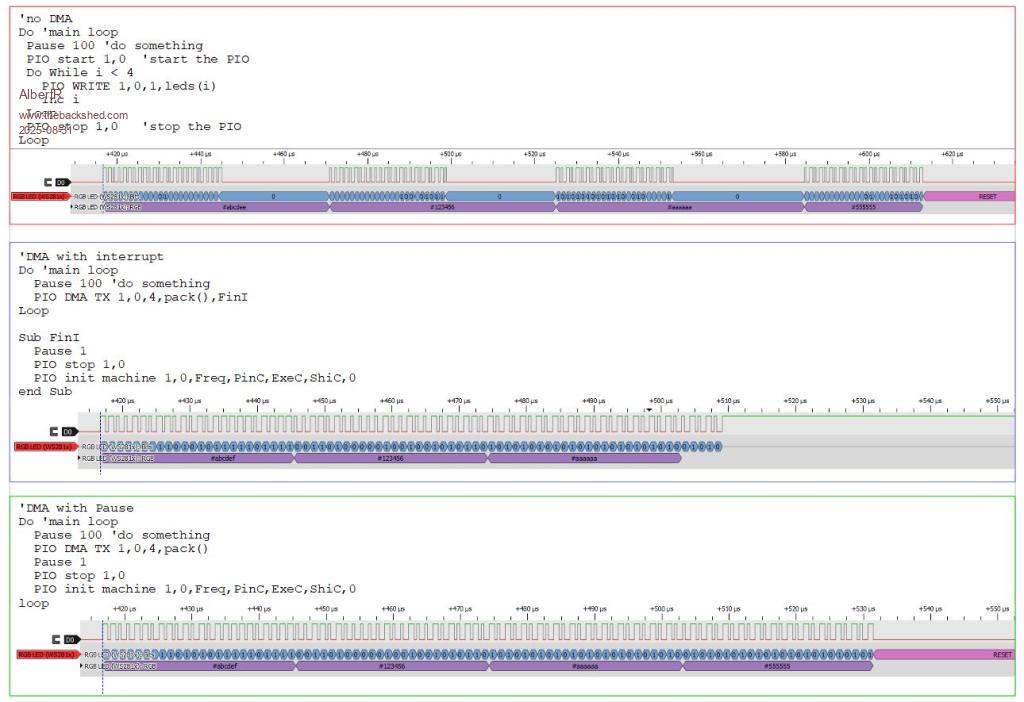
1. PIO WRITE always kills the last bit. If CPUSPEED is only 150MHz it generates a "Break"
2. PIO with TX-DMA works very good but if I use the Ready-Interupt it stops the PIO, even if there is some data left in the OSR and even if there is no PIO STOP in the sub.
3. The version with "pause 1" works spable, but then I am blocking again. That is not what I expected when I use DMA.
I think I am not the only one who use PIO. Where did I thing wrong?
Greetings
Albert |
AlbertR
Senior Member
Joined: 29/05/2025
Location: GermanyPosts: 111 |
| Posted: 12:31pm 31 Aug 2025 |
Copy link to clipboard |
Print this post |
|
Ok, a non blocking solution could be, using a Timer-Interupt with precalculated delay.
'Do 'main loop
Do
' do something
Do : Loop While Busy 'wait for ready
Memory pack leds(),pack(),1024,32 'copy and pack
Busy = 1 'set busy-flag
PIO DMA TX 1,0,1024,pack()',FinI
SetTick 29,FinI,1 ' 29us/24bit
Loop
End
'subs/functions -------------------------------------------------------------
Sub FinI
'stop the PIO and re-init for next run
SetTick 0,FinI,1
PIO stop 1,0
PIO init machine 1,0,Freq,PinC,ExeC,ShiC,0
Busy = 0 'ready to start
End Sub
But is this the right way/solution?
Albert |

 Notice. New forum software under development. It's going to miss a few functions and look a bit ugly for a while, but I'm working on it full time now as the old forum was too unstable. Couple days, all good. If you notice any issues, please contact me.