Notice. New forum software under development. It's going to miss a few functions and look a bit ugly for a while, but I'm working on it full time now as the old forum was too unstable. Couple days, all good. If you notice any issues, please contact me.
OA47 Guru Joined: 11/04/2012 Location: AustraliaPosts: 1051
Posted: 12:12am 16 Mar 2026
Copy link to clipboard
Print this post
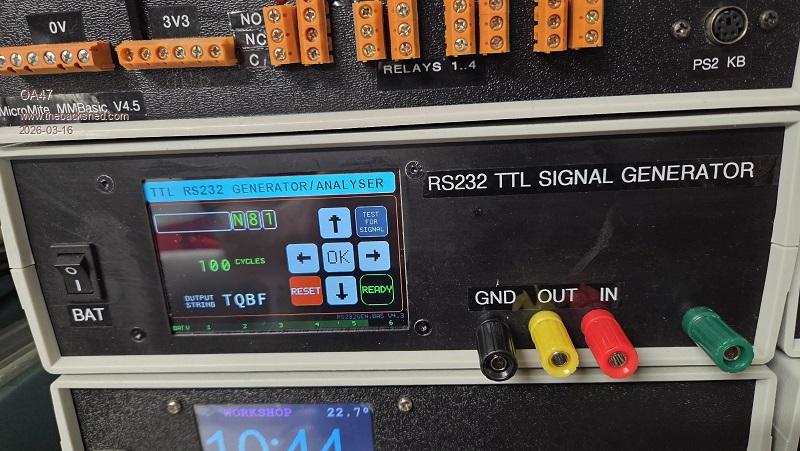
I have a project that uses a Pi Pico to generate a TTL RS232 SIGNAL STREAM and has proven very handy over time. I wanted to incorporate a signal sniffer to identify the rate and bit length of a signal under test. I have used a sample and test procedure that will go through each data rate from 150 to 921600, 7 or 8 bits and 0-2 stop bits. The software tests for a string of ascii characters and when a match is found it reports that rate and bit length. The issue is that it takes an enormous time to accomplish if the sample is at the end of the sweep.
To improve efficiency and accuracy I have thought about measuring the average frequency of the bit stream and honing in on the bit formation of the stream. Rather than rely on AI, I thought BSI may be much more helpful so I was wondering if there could be some input in structuring a routine to accomplish the task.
I think I would capture some pulses, the shortest pulse should give the baud rate away.Too old for bs
phil99 Guru Joined: 11/02/2018 Location: AustraliaPosts: 3381
Posted: 02:27am 16 Mar 2026
Copy link to clipboard
Print this post
CSub LOG would have been perfect for that as it captures the timing of every transition in a bitstream in an array. However it (and most CSubs) is version specific so you would need to compile it for the firmware version you are using.
Another option is the PULSIN() function. Load 2 dozen or so negative pulse times into an array then repeat with positive pulses. The baud rate can then be calculated from the shortest pulse. The longest high pulses (for TTL) may indicate the gaps between bytes. The number of shortest pulses that could fit between those gaps might be used to calculate the total number of bits.
Bytes that are all 1 or all 0 may scupper that idea so would require testing.
Another possibility is to use PIO. In the manual, Apendix F, EXAMPLE PROGRAM 3 is Volhout's 6 channel logic analyzer which could be adapted to capture 6 serial bitstreams at once. Edited 2026-03-16 13:58 by phil99
Volhout Guru Joined: 05/03/2018 Location: NetherlandsPosts: 6118
Posted: 07:51am 16 Mar 2026
Copy link to clipboard
Print this post
Hi Phil,
Initially measuring pulse width is better than the proposed serial port logic analyzer(*). Baudrates vary from 50 to 3meg. That is 1:80000 ratio. The logic analyzer would need to switch samplerates, for it not to run out of memory. But yes, when you are in the correct range it can be used to do some automatic determining of baudrate, 7/8 bits, 1/2 stopbits, parity, etc...
mozzie Guru Joined: 15/06/2020 Location: AustraliaPosts: 432
Posted: 01:22pm 16 Mar 2026
Copy link to clipboard
Print this post
G'day OA47, That's a nice looking unit you have there, along with all the rest Are you starting with a known serial string or is it random data?
I had a similar idea many years ago, and went about it a little different.
Trigger a capture on the start bit (or any bit), and make a fairly long capture. Display this as a scope display with a time graph below, zoom in/out to ascertain bit rate with MK1 human eyeball (is that HI instead of AI)
This was pretty quick once you've done it a few times.
Once the bit rate is known the rest should be relatively easy.
Regards, Lyle.
matherp Guru Joined: 11/12/2012 Location: United KingdomPosts: 11879
Posted: 01:59pm 16 Mar 2026
Copy link to clipboard
Print this post
Wrong thread Edited 2026-03-17 00:14 by matherp
OA47 Guru Joined: 11/04/2012 Location: AustraliaPosts: 1051
Posted: 11:57pm 17 Mar 2026
Copy link to clipboard
Print this post
Thankyou for your replies.
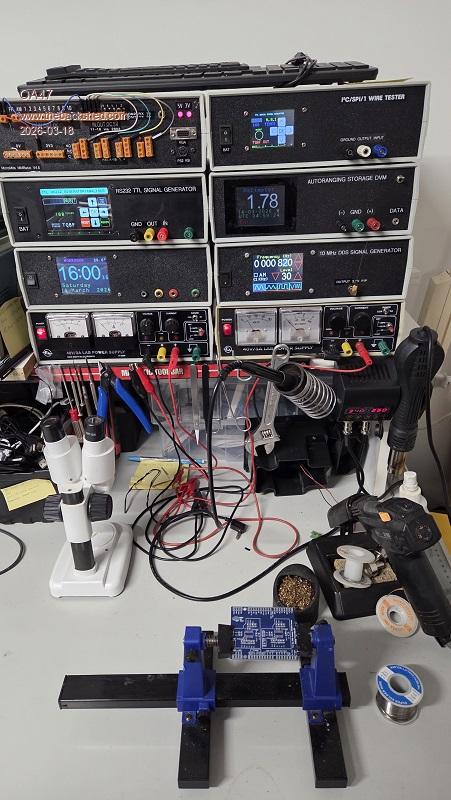
This is the home grown test gear I have put together over the years. Some Pi Pico, some Micromites, some Armmites and all get a bit of software updates as time goes on.

 Notice. New forum software under development. It's going to miss a few functions and look a bit ugly for a while, but I'm working on it full time now as the old forum was too unstable. Couple days, all good. If you notice any issues, please contact me.


 Print this post