Notice. New forum software under development. It's going to miss a few functions and look a bit ugly for a while, but I'm working on it full time now as the old forum was too unstable. Couple days, all good. If you notice any issues, please contact me.
rogerdw Guru Joined: 22/10/2019 Location: AustraliaPosts: 955
Posted: 11:34am 17 Dec 2025
Copy link to clipboard
Print this post
Congratulations Mike, a very tidy looking installation. Just a little bit neater than my good old forklift battery and still uncovered Warpverter and MPPT's.
Did they add more panels too or just hook up what you already had? How many kW?Cheers, Roger
wiseguy Guru Joined: 21/06/2018 Location: AustraliaPosts: 1316
Posted: 11:51am 17 Dec 2025
Copy link to clipboard
Print this post
Thanks Roger, we had 13.5kW of panels on the roof which used to feed a 10KW 3 phase Fronius. They were going to AC couple the existing Fronius, meaning even if we were able to generate 13.5kW it would have only charged the batteries at 10kW. It made more sense to DC couple the panels to the inverter and just remove the Fronius.
I looked on Marketplace and there are at least 6+ 10kW Fronius inverters starting from $100, most refer to a recent battery upgrade. I don't think I will even bother advertising mine, might do a teardown to see what goodies are inside - might be a good source of ringcores suitable for stripping and rewinding as inverter chokes.
Considering they were worth ~ $3K just a few years ago I sense there will be an avalanche of inverters about to flood the "used" market thanks to the recent battery subsidy.If at first you dont succeed, I suggest you avoid sky diving.... Cheers Mike
-dex- Senior Member Joined: 11/01/2024 Location: PolandPosts: 104
Posted: 11:32am 18 Dec 2025
Copy link to clipboard
Print this post
Hi, We have a saying: "a shoesmaker without shoes" – this is in the context of your energy storage system, Mike
My first thought was: what's so crazy about installing an LFP outdoors? But I looked at the winters in your latitude and realized there's no need to worry. In my location, winter temperatures often drop well below 0°C and stay there for many days.
Do you know what type of cell your battery storage uses? Cylindrical cells, such as the EVE C40, are common in these products.
BTW. I haven't been here in a while; my thread should be dusted off and updated
wiseguy Guru Joined: 21/06/2018 Location: AustraliaPosts: 1316
Posted: 12:48pm 18 Dec 2025
Copy link to clipboard
Print this post
Hi Dex, good to hear from you again. How's that inverter running - the warranty period has expired now Today was a warm day in South Australia it reached ~37 Deg Celsius in the afternoon - I won't need to worry about cold batteries for a while yet.
The batteries are Lithium Iron Phosphate types, I read somewhere there are supposedly 9 battery cells each 280AH. I think they may well be EVE LF280Ks ?
However, the pamphlet eludes to "low voltage" but also lists the voltage range in the battery specs as 600 - 900V which is at odds with low voltage. The max power you can draw is 0.5C or 4kW for the 8kWh module.
SigenStor uses LFP (lithium-iron-phosphate) cells with a capacity of 280 Ah, offering several advantages over conventional battery solutions:
Higher reliability and safety: The 280 Ah cells have a lower voltage of 32.85 volts, significantly reducing safety risks compared to conventional solutions that use 100 Ah or smaller cells, which can raise the battery voltage above 91 volts. Extended lifespan: The 280 Ah cells also have a longer lifespan, so the energy storage system remains reliable for many years.
So I can draw the following conclusion I think;
Perhaps the Battery voltage is 33V nominal but there is a boost converter in each battery module that provides the high voltage rail used by the top inverter. Otherwise for its full rated 24kW output the 33V batteries each provide a total of ~ 750A at the rated output which divided between six modules means each battery is providing ~ 125A and I'm confident there are not 750A busbars passing the energy up to the top inverter. Second observation the inverter is too light to be a LV toroidal type, so I conclude it must use HF HV SPWM switching. Edited 2025-12-18 22:54 by wiseguyIf at first you dont succeed, I suggest you avoid sky diving.... Cheers Mike
analog8484 Senior Member Joined: 11/11/2021 Location: United StatesPosts: 224
Posted: 04:54pm 18 Dec 2025
Copy link to clipboard
Print this post
Interesting to see Sigen. What's the warranty? They are still rare in the US with unproven support track record.
Don't know if you have an EV but Sigen offers a V2X module that looks interesting.
wiseguy Guru Joined: 21/06/2018 Location: AustraliaPosts: 1316
Posted: 10:32pm 18 Dec 2025
Copy link to clipboard
Print this post
No we don't own an electric vehicle yet but in a few years it is on the cards. Yes I was aware of Sig's EV support and modules.
I am posting the SIG PDF documents here that I have to hand as they will answer most queries. I am not on a finders fee or receiving commissions etc for Sig referrals......
After doing some research online, mainly from the UK, many of the premium installers there swear by SIG products and after seeing their installs and their efficiency & perceived reliability, I decided to bite the bullet. Initially I was only going to install 16kWh of storage but when the Government started the home battery subsidy scheme the cost of each 8kWh module was only around $1K9 extra so I decided to up the reserve to 48kWh and upgrade the inverter to 24kW 3 phase so on the nights where it doesn't get below 28+ degrees, then we can run the ducted air all night.
The other advantage is that in winter where we typically only use ~ 6kWH per day we could have a week of essentially no sun and no Mains power and still be self reliant.
Last night we did just that and this morning we still had 49% battery capacity remaining & no power consumption from the grid despite running the Air most of yesterday and the batteries started at sunrise yesterday with 0% charge remaining however we only returned ~ 3.5kWh to the grid around 4.00pm yesterday instead of ~ the usual 50-60kWh for a typical day at this time of year).
Now we are starting at ~%50 storage capacity so I estimate we will export ~ 30+kWh today. That will help pay for the "supply" connection which even with no power drawn is $2.19 per day, whilst receiving a whole 0.09c per kWh returned but being charged 68.92c per kWh consumed at the peak rates (where we usually had to consume energy outside of solar generation). Thanks Engie (our provider) what a great deal.....
It does not state implicitly the battery warranty but it implies 10 years which is what sales said (yeah I know) - I will ask for further clarification. Edited 2025-12-19 08:38 by wiseguyIf at first you dont succeed, I suggest you avoid sky diving.... Cheers Mike
analog8484 Senior Member Joined: 11/11/2021 Location: United StatesPosts: 224
Posted: 05:10pm 19 Dec 2025
Copy link to clipboard
Print this post
Thanks for the info.
Only 6kWH per day used in the winter ... you must have a pretty efficient home with gas heating?
wiseguy Guru Joined: 21/06/2018 Location: AustraliaPosts: 1316
Posted: 11:25pm 19 Dec 2025
Copy link to clipboard
Print this post
Ok to clarify the winter 6kWh is essentially the minimum budget power we could get by on if the grid goes down to keep fridges & lights & maybe a PC or TV running and little else.
Yes you are correct we have Gas heating & Gas instant hot water. All lighting throughout the house is via LED downlights. We upgraded from the calculated energy coefficient for insulation and went a couple of grades higher for roof and walls and added sisalation (sarking? dont know if thats what you call it - reflective film under the tiled roof) It all helped make us pretty energy efficient.
Now I have excess electrical energy, our next upgrade will probably be a roof solar water pre-heater feeding into a heat pump hot water system. Edited 2025-12-20 11:19 by wiseguyIf at first you dont succeed, I suggest you avoid sky diving.... Cheers Mike
wiseguy Guru Joined: 21/06/2018 Location: AustraliaPosts: 1316
Posted: 11:39pm 20 Dec 2025
Copy link to clipboard
Print this post
The Sig storage/inverter system has been in & operating, essentially beginning on 18/12/25. I think its only fair to inform now about the negatives of a Sigenergy system and some of its internal workings and secrets. I was checking on our overnight consumption and was alarmed at how high it appeared.
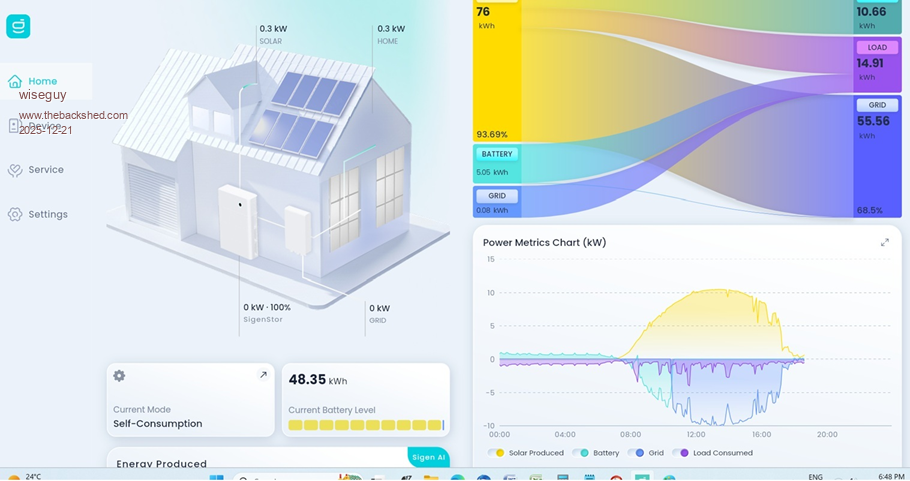
First a bold statement. Overnight my 48kWh system appears to self-consume over 4kWh of standby power or close to 400W continuously, nearly 10% of overall capacity.This has nothing to do with phantom static loads of the house it is just what it requires to exist. So in a typical 24 hour cycle it consumes, I estimate over 8kWH of our solar bank consumption.
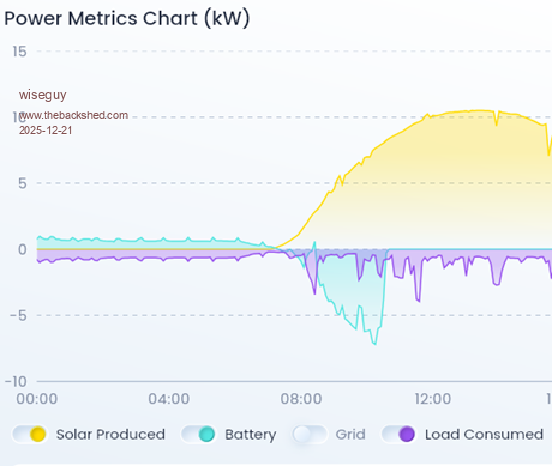
The Sig graphs gave the dirty secret away if you look carefully enough you see it. Overnight there is ~ 650W minimum consumption disguised as house standing load but curiously at ~ 7AM the house minimum standing power remarkably drops to ~ 200W then in the evening around 7pm it increases again back to ~650W. The 7/7 time points align with the beginning of solar start and solar stop for this time of year. I could not understand why the 650W dropped by around 400+ watts before the solar appeared to start in the morning, then I started to realise what was going on & the reverse at dusk. Why was the standing 650W dropping to 200W before the solar appeared to begin?
The energy consumption is hidden in the daytime as the standing inverter self consumption appears to be robbed from the solar energy created before it actually reports on what is the resultant solar generation (ie what is left after we remove ~ 400W from the actual solar generation).
So a check with Mr Google and the first hit revealed some interesting information.
"There was a post in the Sigen app community about a week ago commenting on this. One user suggested 60W for the inverter plus 35W for each 8kWh battery module."
I knew there would be some inverter standing loss and 60W sounds slightly plausible albeit on the very light side for a 25kW inverter, the real shocker (pardon the pun) was for the 6 x 8kWH battery stack to be using over 200W continuously over-night. Some other Sig information on the Web mentions BMS and Battery monitoring and balancing power consumption as the cause. Do we need a balancer overnight when not charging & surely monitoring and BMS should draw less than 5W.
I believe what is going on is that the 32V to 600V converters running continuously in each module is chewing up the extra 30+ watts per battery module. This tells us that the overall trip from batteryV to mainsV ie inverter idle current is really around 400W. I am unsure if the 35W per module was calculated/derived/assumed from the total energy on the HV "bus" to the inverter, divided by the number of battery modules or if the standing current per battery module also increases proportionally for fewer battery modules ?
Sorry for the longish post but if considering a Sig system, be armed with some hidden detail of what is going on internally. Nearly 10% of your battery capacity is not available as it is eaten when the sun isn't shining, and when the sun is shining it takes ~ 4kWH of consumption before you ever see it.
Here is a picture of the Sig information graph. The green is battery energy being used, the lower purple is shown as energy for the house. Look at 6am and you will notice a decline of battery energy supplied to zero at about 7:30 as the solar is now reported to have started generation. The decline in battery energy is caused by the true beginning of solar energy from the panels from ~ 6:am. The 300W house consumption shown was a snapshot of the graph during a house minimum load during solar generation.
Sig information graph
Zoomed in: The house load (violet) & battery energy required (green) magically drops from 650W to ~ 200W before solar supposedly "started"! Battery was fully charged before 11am. Edited 2025-12-21 10:29 by wiseguyIf at first you dont succeed, I suggest you avoid sky diving.... Cheers Mike
wiseguy Guru Joined: 21/06/2018 Location: AustraliaPosts: 1316
Posted: 05:44am 21 Dec 2025
Copy link to clipboard
Print this post
Within 3 days bedlam on Facebook Marketplace, today there are 71 Fronius inverters available in Adelaide from $75 to $2,600 ! The total number of inverters at a quick count is 191! All the high priced ones will get a good reality check very soon, I reckon if they get ~ $50 scrap value for one they should be thankful. Just a few years ago a Fronius price was in the thousands. Is this happening in other states? There should be plenty of ring cores for inverter chokes to be had very cheaply in the near future.If at first you dont succeed, I suggest you avoid sky diving.... Cheers Mike
Godoh Guru Joined: 26/09/2020 Location: AustraliaPosts: 705
Posted: 07:04am 21 Dec 2025
Copy link to clipboard
Print this post
Wow Mike that sounds like a hefty self consumption. Maybe you should start a thread about the Sigenergy battery system so we can keep an eye on it. I have seen something about some of the Sig systems having failures on the power plugs, the claim was that the plugs were not crimped properly but that the company had changed the style of input/output connectors on the single phase units to use Eye Lugs rather than crimped Ferrules. I hope that there is a way to lessen the self consumption that would not be good if there were a few days of heavy cloud in a row. Pete
analog8484 Senior Member Joined: 11/11/2021 Location: United StatesPosts: 224
Posted: 06:14pm 21 Dec 2025
Copy link to clipboard
Print this post
That's a good point. It seems pretty common (even for off-griders) to just buy more solar and batteries instead of investing in high grade insulation.
-dex- Senior Member Joined: 11/01/2024 Location: PolandPosts: 104
Posted: 10:26am 22 Dec 2025
Copy link to clipboard
Print this post
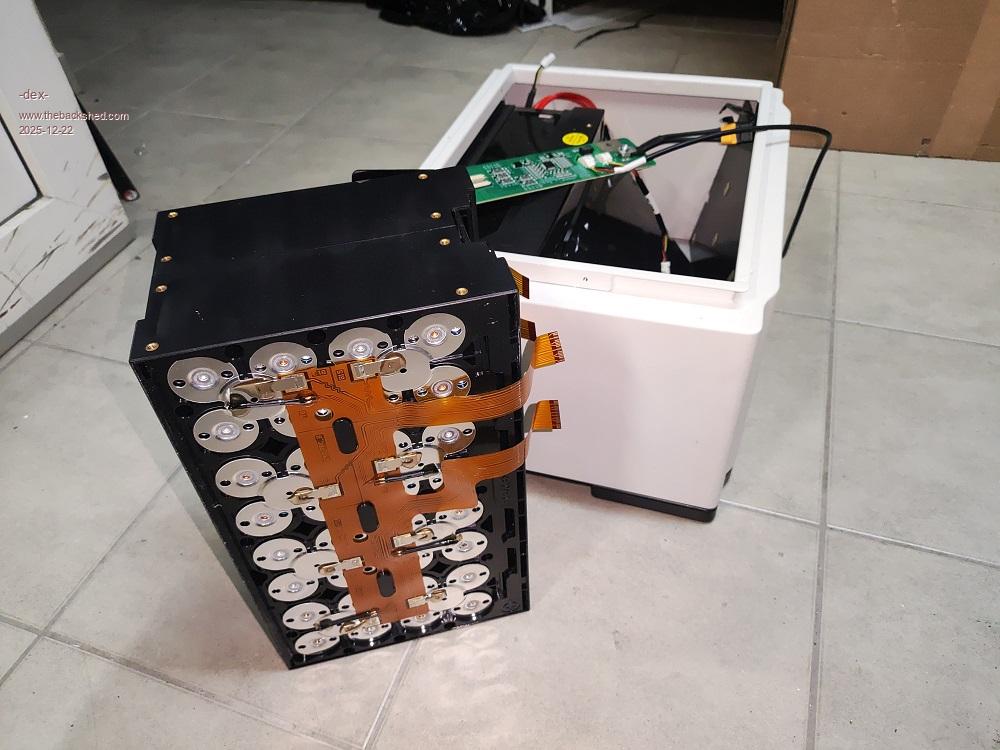
I have a similar commercial product here, very similar to yours, that failed. Actually, I have a lot of them. One single module contains two ~51,2V battery pack inside. They're 2 in series, providing a total of 102,4V. Two black boxes in one white box. These white boxes can be connected in few series, providing high-voltage storage up to several hundred volts.
One black box contains a total of 32 cells in a 2P16S configuration. From reports from other colleagues in the market, I know that many commercial products use this type of cell.
Oh... none of these inverters are LV inverters, or even those equipped with a toroidal transformer.
As for my inverter - It's boring, nothing bad happens, and the house is constantly powered without interruption. Boring - in the positive sense of the word Edited 2025-12-22 21:28 by -dex-
wiseguy Guru Joined: 21/06/2018 Location: AustraliaPosts: 1316
Posted: 10:57pm 22 Dec 2025
Copy link to clipboard
Print this post
I agree boring is really good, especially for something you rely heavily on. How may megawatts of energy has pushed through it so far. At this early stage we should do an MTBF reliability calculation before something bad happens
The commercial unit that failed, tell me more about what functionality failed such as inverter, balancer cell etc. It looks quite well built.If at first you dont succeed, I suggest you avoid sky diving.... Cheers Mike
-dex- Senior Member Joined: 11/01/2024 Location: PolandPosts: 104
Posted: 09:07am 23 Dec 2025
Copy link to clipboard
Print this post
Our inverter has so far operated at about 3.5 MWh over within about 1.5 years. As we can see, our consumption isn't as high as we thoght.
For MTBF... What could be seriously wearing out? Probably the CAPs. I tried to calculate the operating time of my main CAPs when I bought them. There are ready-made formulas and operating time calculators, and I remember that the operating time is a solid several years. It's difficult to assess the wear and tear of contactors and relays. In winter, when there's no sun, the system disconnects and reconnects once a day.These little low voltage converters have an absurdly high runtime-MTBF.
Furthermore, in my inverter, nothing more than 6kW has ever been put into it.
If you are bored, try calculating the MTBF for your inverter In my built MPPT chargers will probably fail (wear out) faster. This is still a short period of time to evaluate working time.
And we're still testing the commercial product in the photo. The devices report an energy storage error due to low voltage cell's error – on some cells, the cell voltage drops below a critical level. This is likely due to lower-quality cells (significant differences between cells, e.g., capacity or internal resistance) or an ineffective/too weak/too slow balancer. Unfortunately, the manufacturer used a passive balancing system here. Edited 2025-12-23 19:09 by -dex-
wiseguy Guru Joined: 21/06/2018 Location: AustraliaPosts: 1316
Posted: 12:48am 24 Dec 2025
Copy link to clipboard
Print this post
Hi -Dex-, My MTBF comment was not meant to be taken so literally. Sure it can be calculated from many hours of work sourcing available component data and calculations (yes extremely boring....) and ends up essentially as a theoretical value. There is also the empirical method which you can look at the number of units running and the number of hours and the corresponding failures.
Obviously data collected over a relatively long period with zero breakdowns is the best scenario for an empirical MTBF as it appears as almost infinite - hence my comment that we should do an MTBF - now before someone has a breakdown issue to spoil the story...
With regard to your LiFePO4 batteries, I have bought back to life many battery packs that had a cell drop below their "allowed" voltage and will stop the charger from charging the pack, returning an error. By dismantling the pack and putting a controlled low current charge into the cell until it has a more normal voltage and trying again the pack will then connect to the charger and work fine again. Edited 2025-12-24 12:32 by wiseguyIf at first you dont succeed, I suggest you avoid sky diving.... Cheers Mike
wiseguy Guru Joined: 21/06/2018 Location: AustraliaPosts: 1316
Posted: 03:46am 26 Mar 2026
Copy link to clipboard
Print this post
In the background I have been mulling over the current WG inverter design. Despite being on holidays travelling, sightseeing etc things of a technical nature are never far from my mind.
The main gripe was having to do a 3D leg bend on the upper Mosfet drain legs to accommodate a ferrite "bead". During the design I thought only the lower FETs were affected but after testing the new PCB board it helped to have the beads on the upper FET drains too.
A solution to this issue needed a slab of uninterrupted design time for me to engineer a solution. In my next post I will present some pictures of the changes that I have incorporated into the new power PCB design.
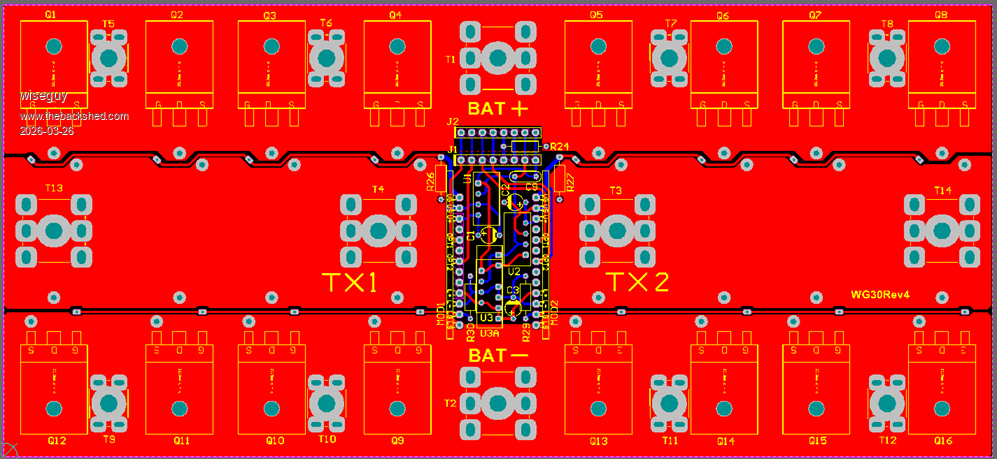
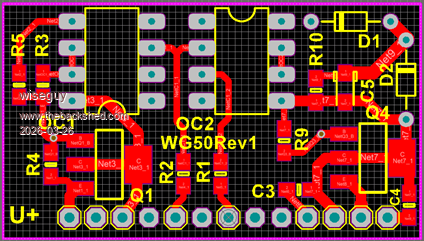
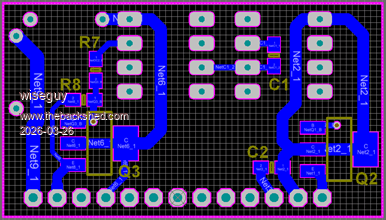
The board dimensions have changed (shrunk) from 18 x 36cm to 18 x 33.6cm. The previous real estate used for the opto couplers and through hole parts has shrunk and instead there are 2 rows of pins for a small vertical sub board for gate drive on each side central to the power PCB.
The sub board has the 2 optos (DIP or Gull wing), gate drive buffer transistors x 4 (SMD) and ~ 13 other 0805 SMD parts, 2 of these PCBs are required. I have tried to avoid SMD parts in the past but these small modules are relatively easy to assemble even with tired eyes and the buffer transistors are only available in SMD now anyway, at least they are the larger SOT223 packages and not SOT 23's !
The small DC/DC converters are mounted central to the power PCB, between the two vertical module PCBs. Note the modules are intended to be soldered, using sockets here by all means do so but at your own risk - I don't recommend it!
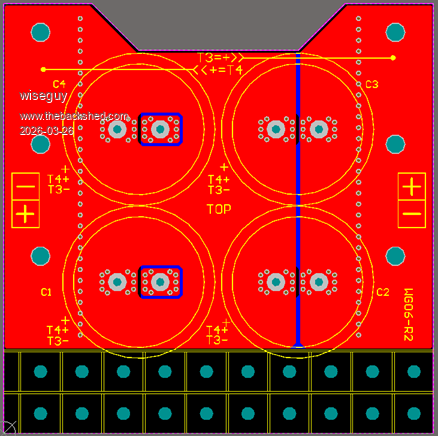
The choke heavy duty connectors can either be soldered near the centre of the power PCB or to the outer edges. The Capacitor PCB are able to be rotated 180 degrees to suit either location. Note the new Cap boards no longer have a rectangular notch out for the choke connectors but a wedge shape leaving more current carrying copper on the PCB. The old Cap boards can be re-used but if reordering boards the new ones are recommended.
I have altered the Upper Mosfet leg bends required to simple 90 degree bends. The PCB Drain hole allows up to a 6mm "bead" to be used with no issues. The resulting lead bend changes means the gate trace now meanders a bit and is no longer a straight line. The gate trace looks a bit narrow, but it now has a second parallel trace on the bottom layer.
The result is that the high current paths for all the FETs travel from ~15 to ~20 mm less PCB trace distance to the high current connectors too.
The only catch here is that I have no plans to order any PCB's for myself at this stage. I am content to use the boards I currently have. The small gate drive modules have been tried and tested on my 12V inverter design and are therefore proven. The Power & Cap PCBs have not been tested but I am confident they will work first time as all previous boards did too (except for a small trace glitch on Rev3.... easily fixed).
Apart from a simpler FET lead bending regime, drilling the FET holes for screw mounting to the heatsink are very regular spacings, ie 22mm, 30mm and 48mm. If you use two aluminium bars as I do, easy! However if you mount the PCB straight to a heatsink face the two rows of holes are spaced apart by 86.6mm so in my case S.E.P.
I am just offering a second choice that simplifies the assembly a bit for any bulk orders that may be currently under consideration.If at first you dont succeed, I suggest you avoid sky diving.... Cheers Mike
wiseguy Guru Joined: 21/06/2018 Location: AustraliaPosts: 1316
Posted: 04:14am 26 Mar 2026
Copy link to clipboard
Print this post
The power PCB:
Cap PCB:
Half Bridge Module, front & back
sorry for the slightly different sizes for front and back designs.... Edited 2026-03-26 14:18 by wiseguyIf at first you dont succeed, I suggest you avoid sky diving.... Cheers Mike
KeepIS Guru Joined: 13/10/2014 Location: AustraliaPosts: 2268
GleamBright Regular Member Joined: 21/04/2025 Location: AustraliaPosts: 43
Posted: 10:40am 26 Mar 2026
Copy link to clipboard
Print this post
Hi Wiseguy, the Aussie build group is poised to group order our boards, but it might not be too late to incorporate these improvements. Do we only nèed to re-quote the power board and how can we get the Gerber files to do so? By PM to you?
Page 14 of 15
Print this page
The Back Shed's forum code is written, and hosted, in Australia.

 Notice. New forum software under development. It's going to miss a few functions and look a bit ugly for a while, but I'm working on it full time now as the old forum was too unstable. Couple days, all good. If you notice any issues, please contact me.


 Print this post