Notice. New forum software under development. It's going to miss a few functions and look a bit ugly for a while, but I'm working on it full time now as the old forum was too unstable. Couple days, all good. If you notice any issues, please contact me.
Frank N. Furter Guru Joined: 28/05/2012 Location: GermanyPosts: 1155
Posted: 09:18am 23 Jun 2026
Copy link to clipboard
Print this post
Apparently, the Pico doesn't start up every time. Just now, the normal startup message appeared, along with a message that drive A had been formatted. After turning it on again, the LCD screen remains black. And there's no heartbeat flashing either!
matherp Guru Joined: 11/12/2012 Location: United KingdomPosts: 12034
Posted: 09:21am 23 Jun 2026
Copy link to clipboard
Print this post
Sounds like the flash is corrupted. Try ville56's nuke. I haven't got a PicoCalc but other than the PicoCalc bios I've set up a H/W analogue and everything works perfectly for me including your library code. There was a change between RC22 and RC23 that affected the format command hence why I asked you to recode that line but RC24 has a minor tweak to that which should fix any potential issue in format$(. Edited 2026-06-23 19:25 by matherp
Frank N. Furter Guru Joined: 28/05/2012 Location: GermanyPosts: 1155
Posted: 09:25am 23 Jun 2026
Copy link to clipboard
Print this post
Can you give me a link to that?
Update: If you can read, you've got a clear advantage! Thanks - I overlooked the post above...
Frank Edited 2026-06-23 19:41 by Frank N. Furter
matherp Guru Joined: 11/12/2012 Location: United KingdomPosts: 12034
Frank N. Furter Guru Joined: 28/05/2012 Location: GermanyPosts: 1155
Posted: 09:47am 23 Jun 2026
Copy link to clipboard
Print this post
Thanks Peter!
Okay, I loaded universal_flash_nuke and then RC24. Unfortunately, the behavior is the same. PicoCalc only starts up sporadically and very rarely. (No heartbeat)
toml_12953 Guru Joined: 13/02/2015 Location: United StatesPosts: 733
Posted: 09:55am 23 Jun 2026
Copy link to clipboard
Print this post
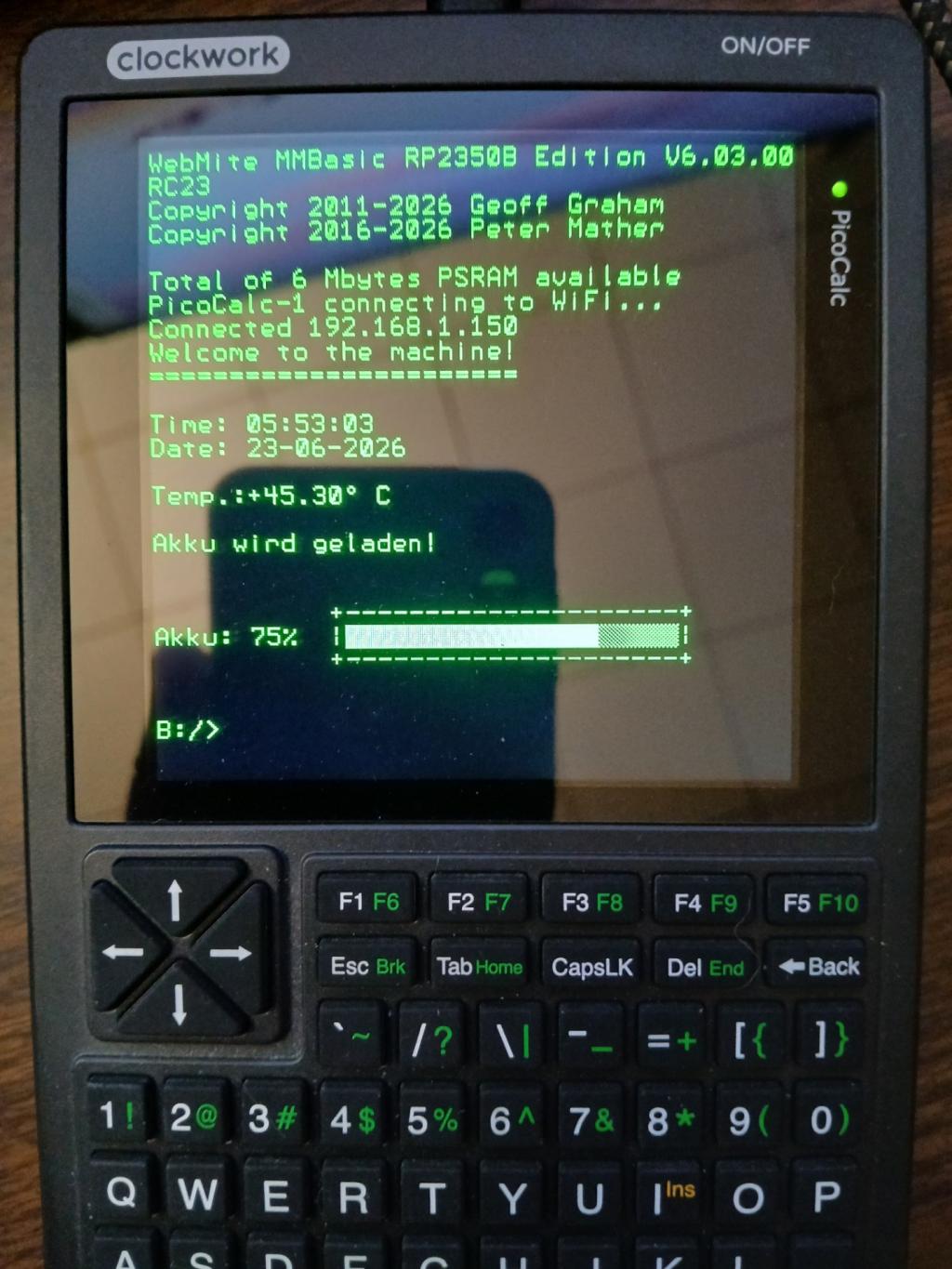
I copied your code into my two PicoCalcs and they worked fine as shown below. Of course, I don't have a temperature sensor attached and it's warm here but not that warm!:
Frank N. Furter Guru Joined: 28/05/2012 Location: GermanyPosts: 1155
Posted: 09:58am 23 Jun 2026
Copy link to clipboard
Print this post
It's not the code. RC22 is still running smoothly for me.
Frank
matherp Guru Joined: 11/12/2012 Location: United KingdomPosts: 12034
Posted: 10:05am 23 Jun 2026
Copy link to clipboard
Print this post
Frank, Given that toml_12953 is running his PicoCalcs on RC23 with your library startup (your original problem setup) then I don't know what more to suggest. You could try different CPU speeds when it does start but......
matherp Guru Joined: 11/12/2012 Location: United KingdomPosts: 12034
Minor internal tweaks Change to OPTION DISK LOAD and OPTION DISK SAVE (Not available in PICOMITEMIN). It now saves/loads a text file with just the options that are different to the RESET condition. This should make it robust across any future builds even if I change the underlying option structure Edited 2026-06-23 20:13 by matherp
Volhout Guru Joined: 05/03/2018 Location: NetherlandsPosts: 6184
Posted: 10:42am 23 Jun 2026
Copy link to clipboard
Print this post
Frank,
Is there a WEBMITE inside the PicoCalc ? toml_12953 uses a webmite. You flashed "PicoMiteRP2350V6.03.00RC23.uf2" which is not webmite.
ville56 Guru Joined: 08/06/2022 Location: AustriaPosts: 641
Posted: 10:44am 23 Jun 2026
Copy link to clipboard
Print this post
Peter,
great improvement to change the option disk to a text file. Makes it easy to modify an existing option set and makes loading much faster then line-by-line. Is there a list of the option names available? I'm fully aware that manually changing the options may have side effects though... 73 de OE1HGA, Gerald
Volhout Guru Joined: 05/03/2018 Location: NetherlandsPosts: 6184
/* Security and communication */ int PIN; int Baudrate; int8_t ColourCode; unsigned char MOUSE_CLOCK; unsigned char MOUSE_DATA; char spare; int CPU_Speed; unsigned int Telnet; // Also stores size of program flash (start of LIBRARY code)
/* Color settings */ int DefaultFC, DefaultBC; // Default colors short version; // 40 bytes
/* Keyboard configuration */ unsigned char KEYBOARD_CLOCK; unsigned char KEYBOARD_DATA; unsigned char continuation; unsigned char LOCAL_KEYBOARD; unsigned char KeyboardBrightness; uint8_t special; // used for special board configurations
/* Font and RTC */ unsigned char DefaultFont; unsigned char KeyboardConfig; unsigned char RTC_Clock; unsigned char RTC_Data; // 60 bytes
/* Touch calibration */ #ifndef PICOMITEVGA int TOUCH_XZERO; int TOUCH_YZERO; float TOUCH_XSCALE; float TOUCH_YSCALE; // 88 bytes #else short Height; short Width; char dummy[12]; #endif
/* GUI or HDMI configuration. Layout rules (the saved-flash struct must stay byte-compatible with prior firmwares for each variant): * Touch-screen builds (GUICONTROLS, !PICOMITEVGA): this 4-byte slot holds MaxCtrls + spare3[3]. Unchanged. * Legacy HDMI/VGA builds (PICOMITEVGA, !GUICONTROLS): this slot holds the HDMI lane mapping. Unchanged. * New mouse-GUI VGA/HDMI builds (both flags): we keep the HDMI lane mapping in this slot for binary compatibility, and stash MaxCtrls in the first byte of extensions[] further down. */ #if defined(GUICONTROLS) && !defined(PICOMITEVGA) // uint8_t MaxCtrls; unsigned char spare3[4]; #else uint8_t HDMIclock; uint8_t HDMId0; uint8_t HDMId1; uint8_t HDMId2; #endif
/* Platform identification and extensions */ unsigned char platform[32]; uint8_t BACKLIGHT_KBD; // *EB* uint8_t BACKLIGHT_LCD; // *EB* uint16_t D4; // *EB* unsigned int GPSBaud; // *EB* unsigned char pins[8]; // General use storage for CFunctions unsigned char wifi_country_code; // // #if defined(GUICONTROLS) && defined(PICOMITEVGA) /* On mouse-GUI VGA/HDMI builds MaxCtrls rides at the front of extensions[] because the offset-88 slot is kept for the HDMI lane mapping (see above). Total region size stays 79 bytes so the surrounding flash layout (and the 7-XMODEM-block size) is unchanged. */ uint8_t MaxCtrls; uint8_t Resolution; uint8_t VRes_reserved; bool Multi; #ifdef PICOMITEHDMIWEB /* HDMIWEB defines BOTH PICOMITEWEB and PICOMITEVGA, which were previously mutually exclusive. Two slots near the top of the struct that used to overlay each other now coexist, costing +4 bytes: TCP_PORT/ServerResponceTime (PICOMITEWEB) and X_TILE/Y_TILE (PICOMITEVGA). HDMIWEB also needs mousespeed (+4, USB mouse + GUICONTROLS — the plain WebMite stores it in the network-overlay region HDMIWEB uses for real WiFi config). Both costs are reclaimed from the extensions[] spare pool: mousespeed(4) + extensions[67] = 71, i.e. 4 fewer than the normal extensions[75], so the whole struct stays exactly 896 bytes (== 7 XMODEM blocks). */ float mousespeed; unsigned char extensions[67]; #else unsigned char extensions[75]; // 896 bytes == 7 XMODEM blocks #endif // #else // unsigned char extensions[79]; // 896 bytes == 7 XMODEM blocks // #endif
#if defined(PICOMITEBT) || defined(PICOMITEBTH) || defined(PICOMITEHDMIBTH) /* BLE bond storage. Two virtual flash banks of 1 KB each backing the btstack TLV — keeps the LTK alive across reboots by riding along with SaveOptions(). Living inside Option means MMBasic's flash layout treats it as part of the protected 4 KB options sector and won't ever overwrite it. PICOMITEBTH / HDMIBTH store bonded-keyboard LTKs in the same field. */ unsigned char bt_tlv[2048]; #endif
/* NOTE: To enable older CFunctions to run, any new options MUST be added at the end of the list */ } __attribute__((packed));
Edited 2026-06-23 20:55 by matherp
ville56 Guru Joined: 08/06/2022 Location: AustriaPosts: 641
Posted: 10:56am 23 Jun 2026
Copy link to clipboard
Print this post
sorry, I have to rephrase my question: Is there a list of the option names as used in the saved file available?
e.g. BGR=1 does set which option to 1 73 de OE1HGA, Gerald
Frank N. Furter Guru Joined: 28/05/2012 Location: GermanyPosts: 1155
Posted: 11:00am 23 Jun 2026
Copy link to clipboard
Print this post
Peter, I've discovered that if I don't turn on the PicoCalc and connect it to the computer ONLY via the micro-USB cable, I can establish a serial connection. It seems as though the firmware doesn't recognize that it's a PicoCalc:
> [?7hoption list PicoMite MMBasic RP2350A V6.03.00RC24 OPTION FLASH SIZE 4194304 OPTION COLOURCODE ON OPTION CPUSPEED (KHz) 200000 > [?7h
After the OPTION RESET, the PicoCalc settings remained unchanged, but the behavior did not change.
Lowering the CPU speed to 200000 didn't help. The PicoCalc only starts up if I first connect the micro-USB cable and then turn on the PicoCalc. At 200000, I also see a lot of tiny dots on the display. I've never seen anything like this before.
I don't have any problems with RC22.
Frank
Frank N. Furter Guru Joined: 28/05/2012 Location: GermanyPosts: 1155
Posted: 11:02am 23 Jun 2026
Copy link to clipboard
Print this post
No, it's a "normal" RP2350 Pico2...
Frank
matherp Guru Joined: 11/12/2012 Location: United KingdomPosts: 12034
Posted: 11:26am 23 Jun 2026
Copy link to clipboard
Print this post
What happens if you power on with a USB-C connected (i.e. battery charging)?
Page 28 of 31
Print this page
The Back Shed's forum code is written, and hosted, in Australia.

 Notice. New forum software under development. It's going to miss a few functions and look a bit ugly for a while, but I'm working on it full time now as the old forum was too unstable. Couple days, all good. If you notice any issues, please contact me.


 Print this post
 Thanks - I overlooked the post above...