| Menu | JAQForum Ver 19.10.27 |
| Menu | JAQForum Ver 19.10.27 |
Forum Index : Electronics : EG8010 frequency Accuracy
  Page 2 of 2 Page 2 of 2 |
||||||
I also notice that you can purchase custom frequency crystal oscilators from Digikey in qtys of 1 pcs for $7 cad with 15 ppm/C. Not 5v compatible, but if you put a 3.3v regulator in there, it should be able to provide 3v p-p output, which may be enough. SG8101 |
||||||
Hi Greg, Thanks for the detailed look at the data sheet and calculation. Regarding supply voltage, I have a 3.3v regulator and will try it. I know that the EG8010 will work with 3.3v clocking as I have already tried it with a 3.3v vcxo. Will also try NTC/PTC if needed. |
||||||
Hi Greg, Thanks for this. Will also try this, as this is simpler component wise. Have you tried this? |
||||||
No, I am no longer using the EG8010. |
||||||
Update: While waiting for my parts, I installed the EGS002/LTC6900 with the unknown resistor TCRs to compare appliance clock displays with cell phone clock. So far they are within minutes of each other. With the original 12MHz the EGS002 will show an increase of about 4 minutes in 1 day. Unfortunately, we have no sun yesterday and my batteries ran out of charge and my ATS's switched all my loads to grid early this morning. So, my test is only for about 1-1/2 day. And just now Digikey emailed me that my SG8101 order is delayed. So, I will have to do extended testing with the EGS002/LTC6900. |
||||||
What a great find - I feel like I almost live on the Digikey site and had no idea this part existed ! Tim not sure if the 3V3 will drive the EG8010 but if it needs higher drive the simplest FET 3V3 to 5V translator circuit below should work fine. It will add around 1mA to the consumption. Untried Clock circuit with 3V3 to 5V translation. 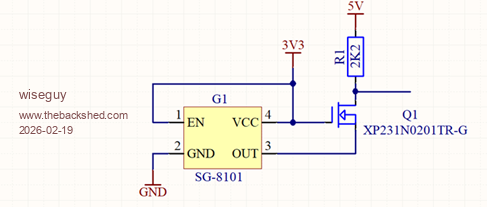 The little FET has 6.5pF input capacitance, the SG8101 is specified as 15pF output capacitance Max. There are not many FETs that would suit this app - maybe you could add a couple to your delayed Digikey order (39c ea $AU) ? |
||||||
I think at some point, that someone at digikey is going to realize they can't make much of a profit programming one pc and selling it for $7 cad. I could be wrong though. |
||||||
Thanks for the circuit and mosfet PN. In my early testing I used this 3.3v VCXO and in the EGS002 circuit, the scope shows the SPWM outputs. But you are right, it is better to feed it with the right voltage level to prevent possible instability. |
||||||
Digikey sells 1-9 pcs for $6.82, 10-24 pcs for $5.93. Assuming the same shipping cost for 1 pc or 10pcs, I ordered 10 so I will have plenty of spares. They shipped yesterday and checking the tracking now, estimated delivery is 2-23-26. |
||||||
So, I 'scoped the OSC1 of an un-modified EGS002. And it looks like it can work with a 3.3v oscillator. But, I still need to test. 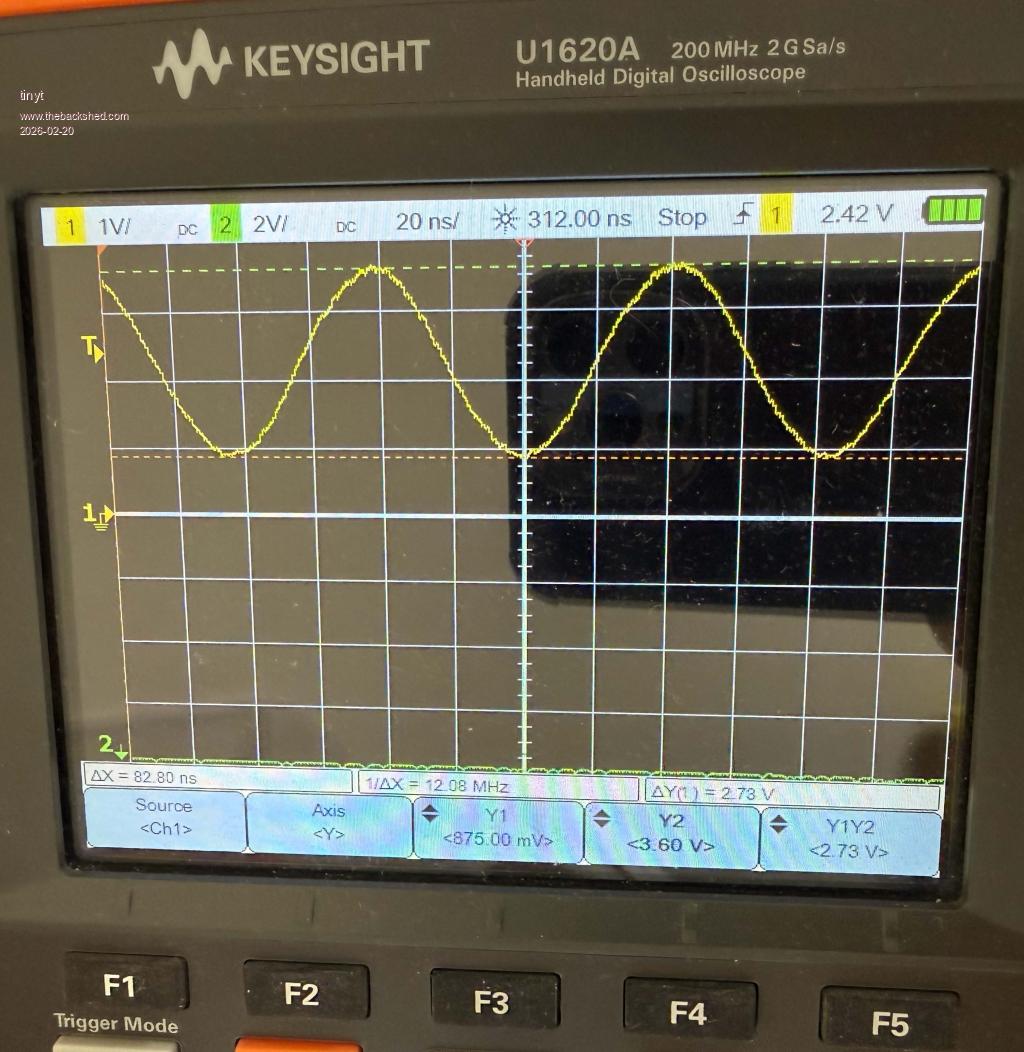 Edited 2026-02-20 01:55 by tinyt |
||||||
Wow you are much braver than I. I would have bought 1 to test and then if everything worked, I would order more. |
||||||
Here is the cost breakdown for the 10 pcs. Unit price - $5.93 Subtotal - $59.30 Tax - $5.19 Shipping - $6.99 Grand total - $71.48 Since the part is very small, I assume that even 1 piece will have a shipping cost of $6.99 but the Tax will be less. So for 1 piece the unit price is $6.82. Grand total - $14.58 But I have built 3 inverters, so I need 3 minimum with no spares. So for 3 pieces the unit price is still $6.82. Grand total - $29.78 If I buy 9 pieces (6 spares) the unit price is still $6.82. Grand total - $75.38 But I bought 10 pieces (7 spares) the unit price is lower at $5.93. Grand total - $71.48 Thinking like my wife, I saved $3.90 and I also have 7 spares.  |
||||||
Finally got the EGS002 modified with the SG8101(11.965722 Mhz). It's 3.3 volts vcc comes from a TPS7A0533 ldo regulator. I also added a .1 uf bypass capacitor. 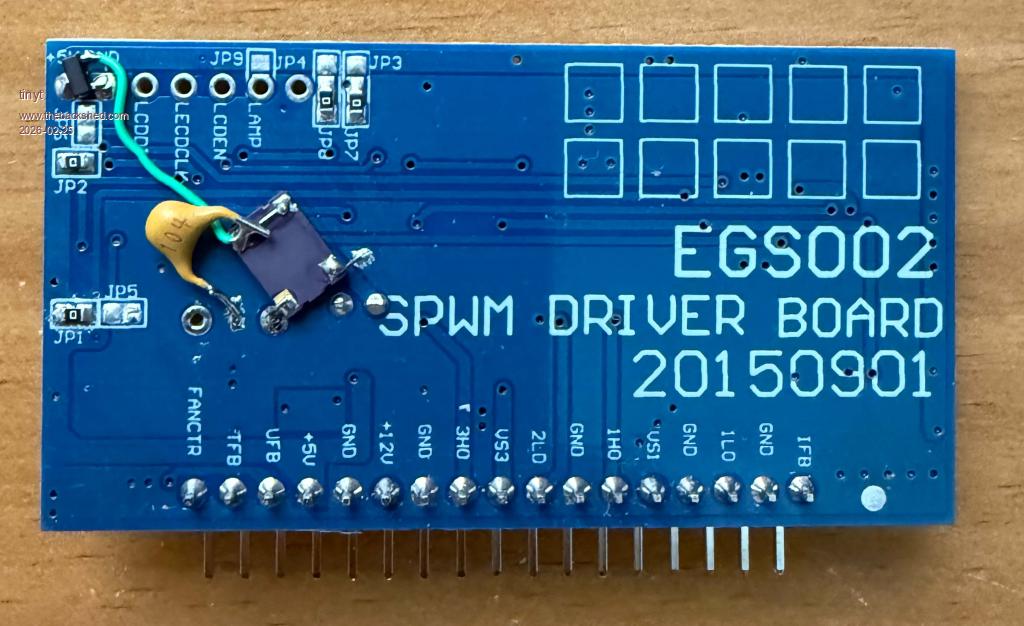 Here is my crude frequency counter test result. It is slightly lower than 60Hz. Hoping the error is just my code. I will find out after several days if it is going to loose time. But I think it will be much better than with the 12 mHz crystal. 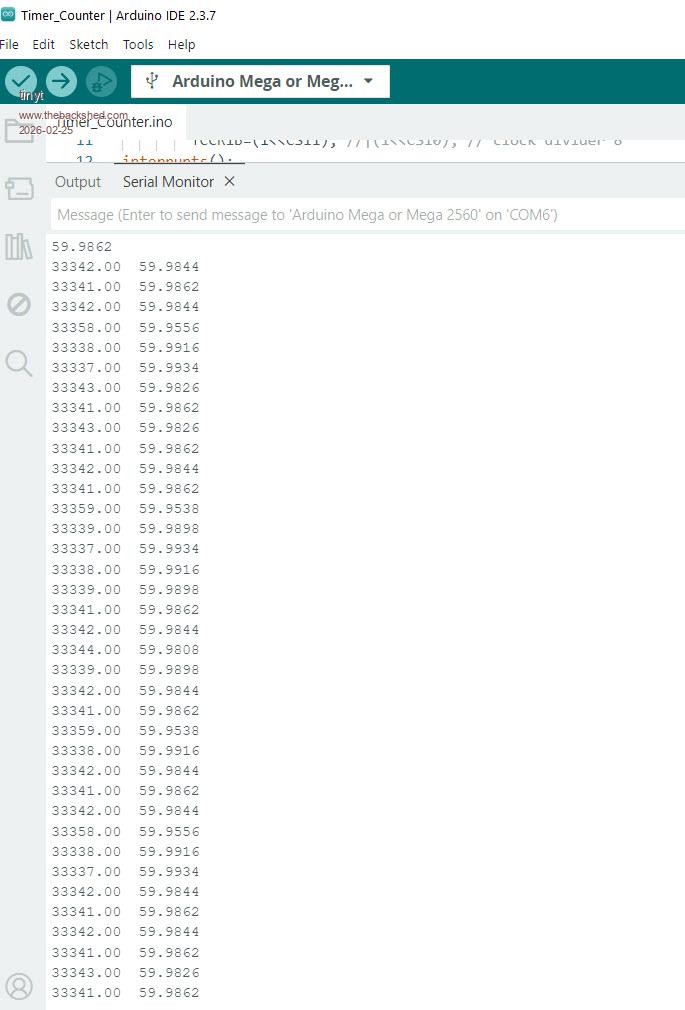 Edited 2026-02-25 11:40 by tinyt |
||||||
You can test that by hooking it up to a mains transformer. If that also gives a 59.98 average after measuring at a few random times over a day your inverter will be ok. |
||||||
Already did it here: That small sample averages to 59.99814 Hz Maybe I and my two sons who has the other inverters can tolerate it. Edit: I did some calculations based on my test data. It seems that an SG8101 frequency of 11.97263 mHz will make it closer to 60 Hz. But, for now I will use what I have. Edited 2026-02-25 14:36 by tinyt |
||||||
| Page 2 of 2 |
||||||
 |
The Back Shed's forum code is written, and hosted, in Australia. |